Open by default
Read the paperwork before you read the label.
Most food brands ask you to trust an adjective. We would rather hand you the batch number, the lab name and the number that came back. Everything on this page is published whether or not it flatters us.
- 0%
- of batches panel-tested
- 0
- pesticides screened
- 0
- named sourcing partners
- 0
- batches held in 2026
Not a sample. Every batch, before it is released.
FSSAI list plus the EU residue panel on tea and coffee.
Every one of them nameable, visitable and paid above mandi rate.
Held, re-worked or destroyed. We publish those too.
Where it actually comes from
Nine places, named.
Every jar and every tin carries a batch code that resolves to one of these. Not a region — a specific herd, estate or slope.
Boundaries are indicative and simplified for the web. The nine points are real coordinates — choose one and the map flies to it.
The Old Mill
Kotagiri, The Nilgiris
Churn floor, roastery, stone wheel and packing hall. Est. 2016.
11.420°N, 76.860°E
Batch lookup
The code under your lid.
Every jar, tin and pouch carries a batch code. Type it in and you get the herd or garden it came from, the morning it was made, who made it, and the full panel that let it leave the building.
No jar to hand? Try
Recently released
| Batch | Product | Made | Laboratory | Outcome |
|---|---|---|---|---|
| GH-2607-14 | Gir A2 Bilona Ghee | 14 July 2026 | Equinox Labs, Bengaluru | Released |
| CO-2607-08 | Chikmagalur Peaberry | 11 July 2026 | TÜV SÜD, Chennai | Released |
| TE-2606-22 | Darjeeling Second Flush | 28 June 2026 | Equinox Labs, Bengaluru | Released |
| GH-2606-09 | Sahiwal A2 Bilona Ghee | 19 June 2026 | Equinox Labs, Bengaluru | Released |
| GH-2606-04 | Kankrej Danedar Ghee | 6 June 2026 | Equinox Labs, Bengaluru | Held · re-churned |
| TE-2605-17 | Assam Orthodox Breakfast | 24 May 2026 | TÜV SÜD, Chennai | Released |
GH-2606-04 was held because the grain set unevenly across the batch — a texture fault, not a safety one. It was re-churned into cooking ghee and sold at the mill gate at cost. We would rather publish that line than quietly delete it.
Independently checked
Four things we can prove.
Tap any of them for the method, the limit of detection and how often we run it.
Like for like
Why it costs what it costs.
We are dearer than the jar beside us on the shelf. Open the price up and the difference stops being a mystery — it is mostly milk, and then it is mostly people.
One jar, taken apart
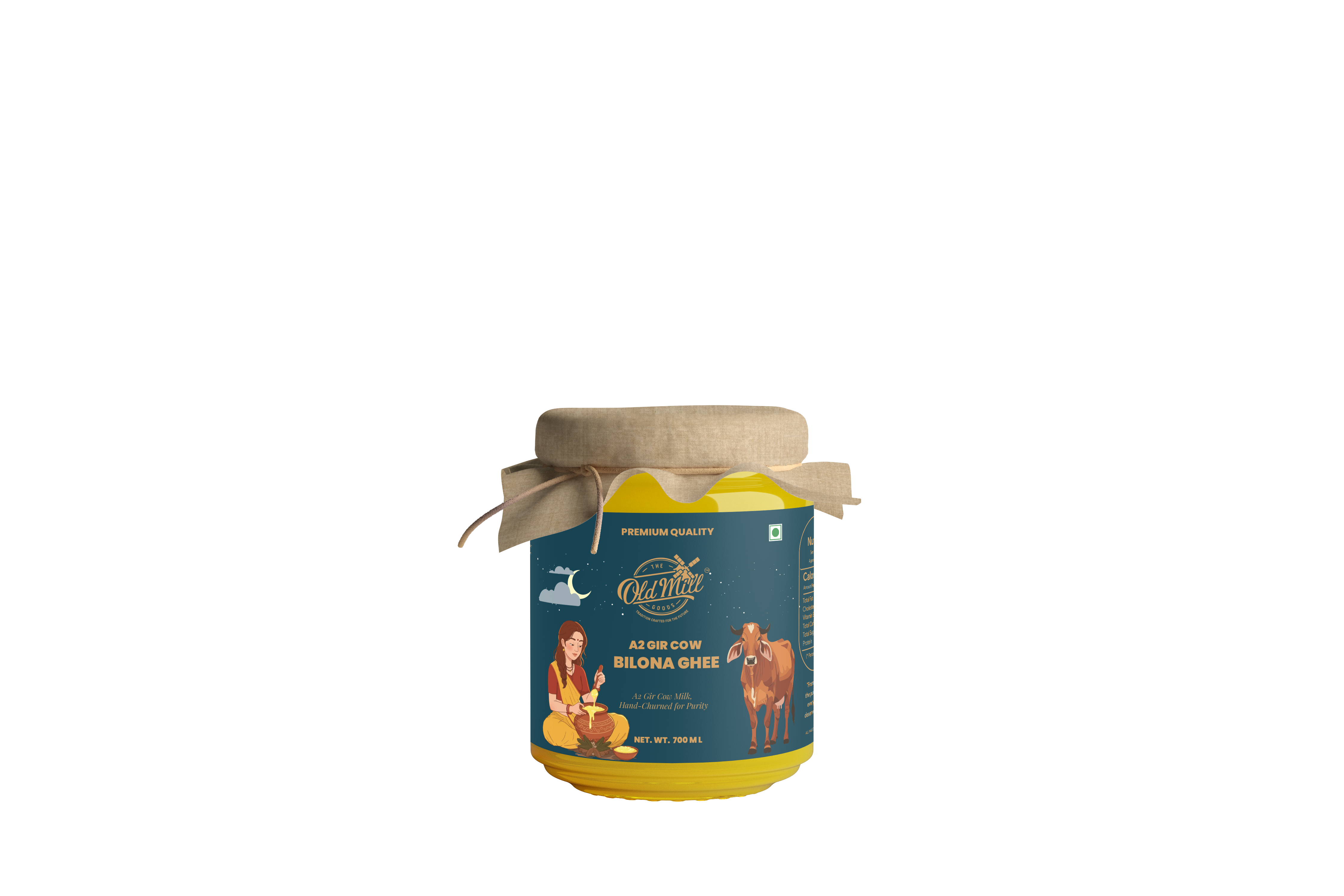
Gir Cow A2 Bilona Ghee
500 ml jar — where each rupee of it goes
₹1,450
₹651
45% of what you pay
The milk
Ten and a half litres of it — 21 litres of A2 Gir milk make one litre of ghee, and this jar is half a litre. Eleven families in Junagadh are paid ₹62 a litre on a rate fixed for the year, not for the day the market dips.
On the cheaper shelf: A commodity jar starts from roughly five litres of centrifuged cream, bought at spot.
The five add up to ₹1,450 — the price printed on the jar. Figures are drawn from a real batch and rounded to the rupee.
Held up against
| What is being compared | The Old Mill | Commodity ghee |
|---|---|---|
| Made from | Overnight-set curd | Cream, centrifuged |
| Churn | Wooden bilona, by hand | Industrial separator |
| Milk per litre | 21 litres | 10–12 litres |
| Breed | Indigenous A2 only | Mixed / crossbred |
| Heat source | Wood, ~4 hours | Steam jacket, 45 min |
| Adulterant panel | 11 markers, every batch | Statutory minimum |
| Lab report | Published per batch | On request |
| Traceable to herd | Yes — printed on jar | No |
Want the raw certificate?
Ask and we will email the signed PDF.
Send us a batch code and we will send back the laboratory’s own report, on their letterhead, unedited. Institutional buyers, dietitians and anyone simply curious — same answer, same day.
FSSAI licence 10021064001729 · GSTIN 33AAKCT2916Q1ZP