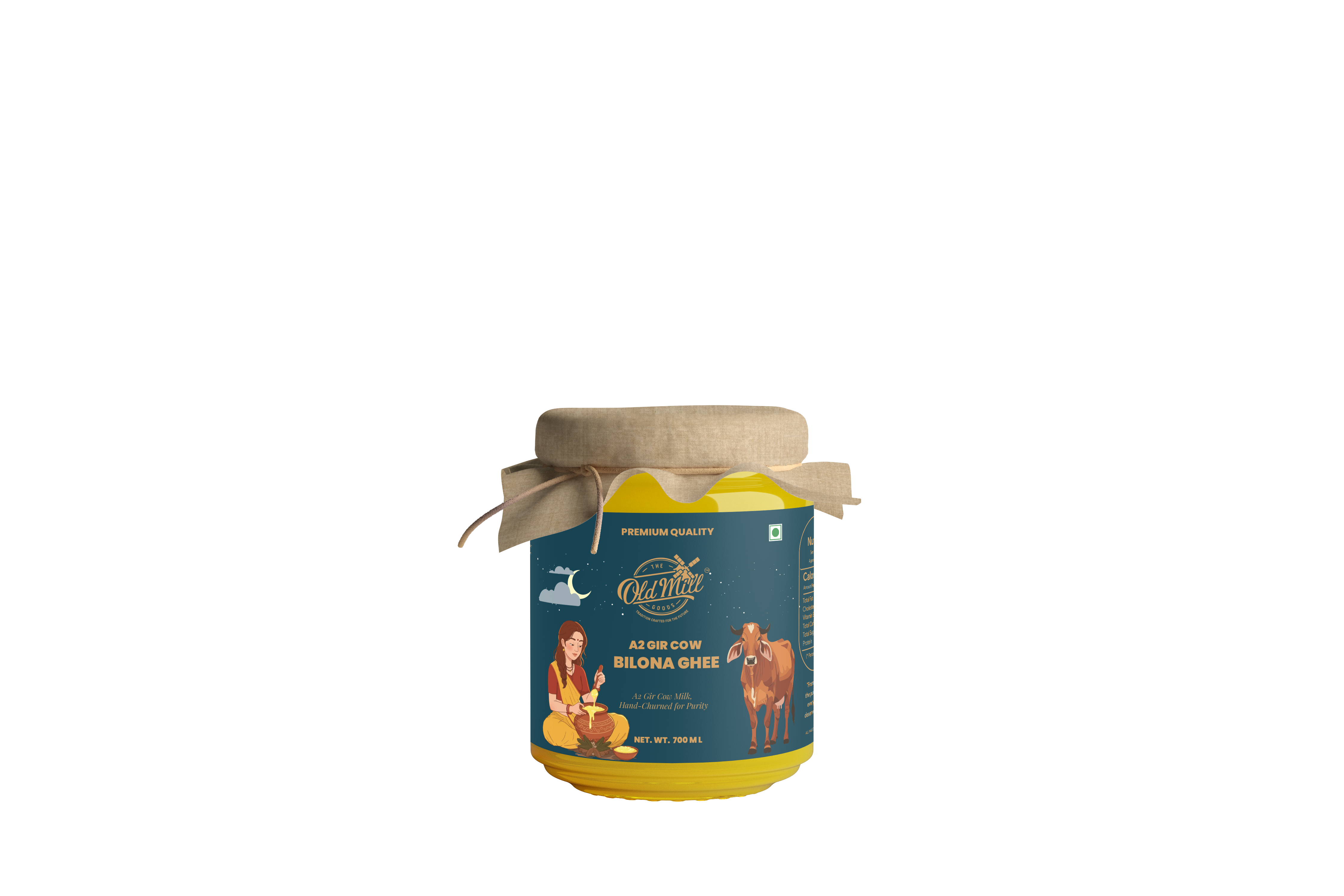
People write to us about the price more than anything else. It is a fair question and it deserves an actual answer rather than a paragraph about heritage, so here is the arithmetic.
Start with the milk
A litre of Gir cow milk carries roughly 4.5% fat. Set it into curd, churn it, and you recover makhan at somewhere between 4 and 4.7% of the original volume, depending on the season and how cold the churn room is. Cook that butter down and you lose the remaining water and the milk solids — another 18 to 20%.
Run the numbers honestly and you land between 20 and 22 litres of milk per litre of finished ghee. We say 21 because that is our running average across a year, and we would rather quote the average than the best month.
Why the cream method is cheaper
Centrifugal separation pulls cream off raw milk directly, skipping the curd stage entirely. It is faster, it needs less labour, and it recovers more fat because none is left behind in the buttermilk. A cream-based ghee can be made from 10 to 12 litres of milk.
It is not fraud. It is a different product. It has less of the lactic character that fermentation creates, a shorter aroma, and none of the buttermilk by-product that the curd method leaves behind — which, incidentally, goes to the families who work at the mill rather than being sold.
What the four hours cost
- Milk at farm-gate A2 rates, which run roughly 60% above pooled commodity milk.
- Ninety minutes of hand-churn labour per batch — the largest single line after milk.
- Wood fuel, and a person watching the pot for close to four hours.
- Amber glass, which costs about nine times what a PET jar does.
- An NABL adulterant panel on every batch, not every quarter.
A litre of ghee that costs ₹700 is not cheating you. It is simply not made this way, and it cannot be.
We are not arguing that everyone should buy the expensive one. We are arguing that you should know which one you are buying, and that the number on the label should be checkable. Ours is. Weigh the jar, read the batch report, ask us for the herd.
Written by Suresh Kariappa, mill manager.