Ayurvedic texts describe ghrita as dipana and pachana — kindling digestion and helping the body process what it has eaten. Modern nutrition talks about short-chain fatty acids and colonocyte fuel. These are not the same framework, and pretending they are is intellectually lazy. But they do overlap at one specific compound, and that overlap is worth understanding properly.
Butyrate
Butyric acid is a four-carbon short-chain fatty acid. It is the preferred energy source for the cells lining the colon — they metabolise it directly rather than drawing glucose from the blood. Most of the butyrate in your body is produced by gut bacteria fermenting dietary fibre. A smaller amount comes in through food, and ghee is among the densest dietary sources, at roughly 3 to 4% of its fat content.
What we can say with confidence: butyrate matters to colon health, and ghee contains meaningful amounts of it. What is less settled: how much dietary butyrate survives to reach the colon, versus being absorbed in the small intestine first. The honest position is that ghee is a useful contributor and not a substitute for eating fibre.
The fat-soluble vitamins
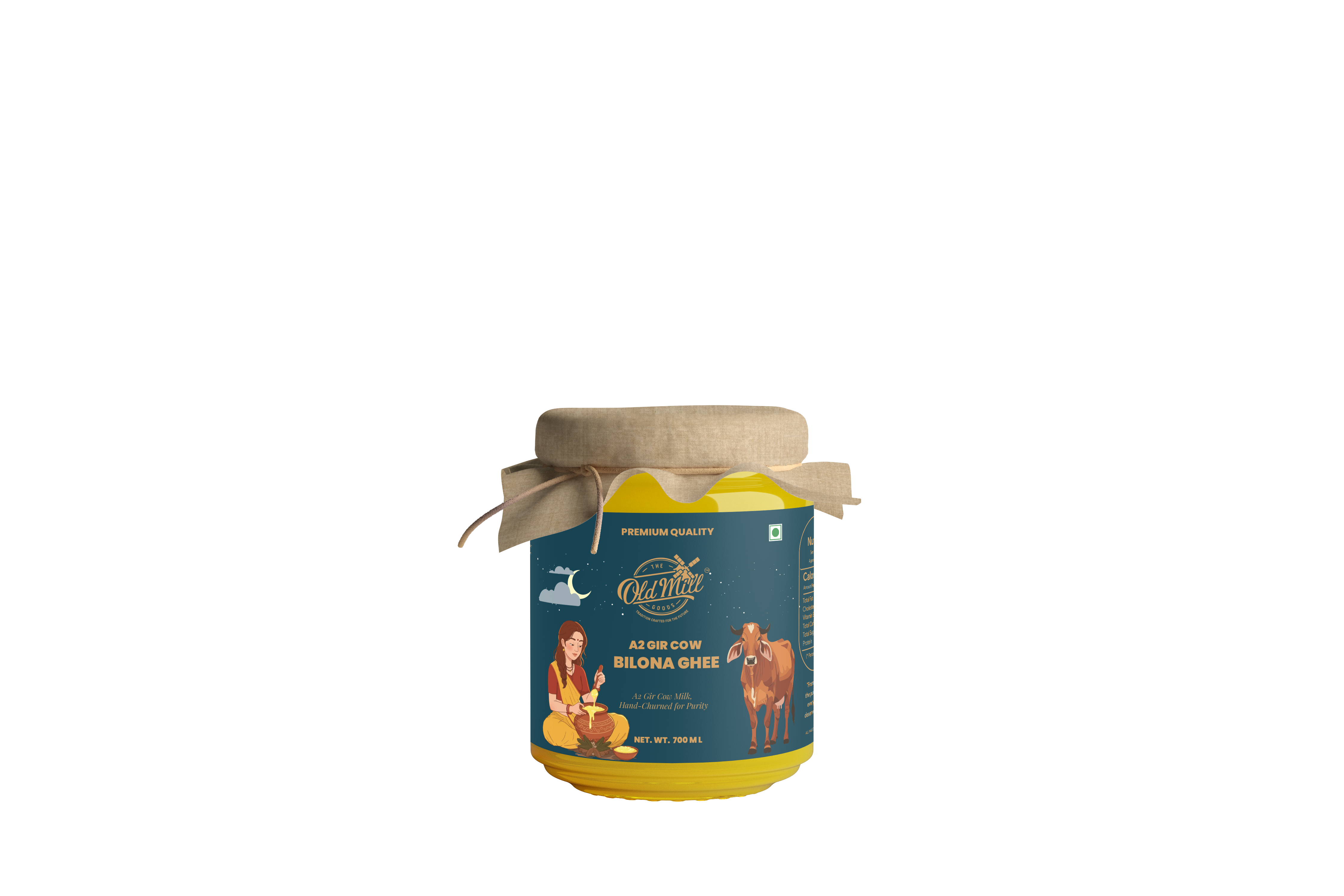
This part is less contested. Vitamins A, D, E and K2 require fat for absorption. Grass-fed ghee carries all four, and notably carries vitamin K2 in the MK-4 form, which is associated with calcium metabolism. The colour tells you something real here — the deep yellow of a Gir cow ghee comes from beta-carotene in fresh pasture, and a pale ghee from shed-fed cattle simply has less of it.
The traditional practice of finishing a meal with ghee is, functionally, an absorption strategy. The texts arrived at it without the vocabulary. The vocabulary arrived later.
Where the claims go too far
- Ghee does not cause weight loss. It is 900 kcal per 100 g and behaves accordingly.
- It does not "cleanse" anything. That is not a physiological process.
- It is not lactose-free by definition — a poorly clarified ghee retains trace milk solids. Ours tests below 0.1%, but ask before assuming.
- It will not undo a diet that is otherwise poor, and no food does.
Our position is straightforward: ghee is an excellent cooking fat with a genuinely useful nutrient profile and a very high smoke point. Use it as a fat, in reasonable quantity, in place of refined seed oil. That is the claim we can stand behind, and we would rather make a defensible claim than an exciting one.
Written by Dr. Ipsita Nair, consulting nutritionist.